About Me
Hi, I’m Katy.
It’s nice to meet you.
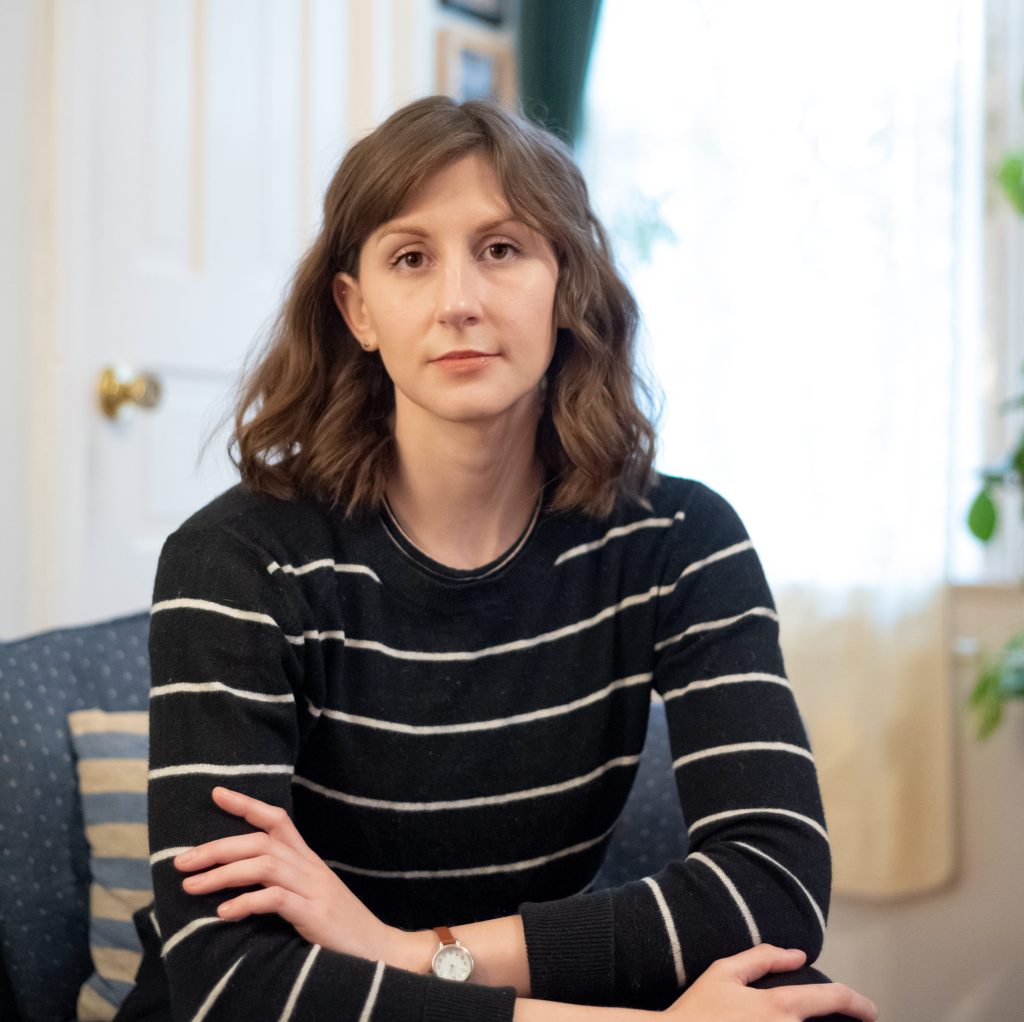
Training and experience
I earned a master’s degree of social work (MSW) with a concentration in clinical interpersonal practice from the University of Michigan. My bachelor’s degree is in nursing (BSN) and is from Eastern Michigan University. I am licensed as a clinical social worker and a registered nurse in the state of Michigan.
As a student therapist, I interned at The Women’s Center of Southeastern Michigan and held a caseload of 8-12 clients for a year’s time under the supervision of Vanessa Marry, LMSW, while undergoing many hours of professional development including weekly trainings provided by a wide range of local therapists and weekly group supervision with a large group of senior supervisors with decades of experience. After graduating, I went on to work for several years as a therapist at Room To Talk, a program of The Women’s Center, under the supervision of Katie Kidle, LMSW, clinical director.
Additionally, I have over seven years of experience navigating acute behavioral health concerns within emergency departments as an emergency nurse and over four years of experience designing and facilitating healthy relationship skills workshops as primary prevention against intimate partner violence in queer communities.
I currently receive ongoing Emotionally Focused Couples Therapy supervision with EFCT certified therapist Cait Edwards, LMFT, LPC. I am also an active member of a couples consultation group, a liberatory therapy consultation group, and an EFT consultation and learning group.
Trainings
- Tending the Future of Care: Practices & Possibilities for Transformative Mental Health | Institute for the Development of Human Arts
- LGBTQ+ Emotionally Focused Couples Therapy Core Skills | trainers Robert Allan and Sandra Taylor
- LGBTQ+ Emotionally Focused Couples Therapy Externship | trainers Robert Allan and Sandra Taylor
- EMDR 2-day training | PESI; trainer Megan Salar
- Somatic Attachment Healing Summit | The Embody Lab
- The Advanced Master Program on the Treatment of Trauma | National Institute for the Clinical Application of Behavioral Medicine
- Cultivating Resilience: Change, Connection, and Skillful Action | Strozzi Institute
- Listen, Empathize, Agree, Partner training for behavioral healthcare | The Leap Foundation
- Non-violent Crisis Intervention | Crisis Prevention International
- Mental Health First Aid | Mental Health First Aid USA
- Philadelphia Trans Health Conference | The Mazzoni Center
- 40-hour Crisis Intervention training | SafeHouse Center
Intensive graduate independent study in the Power, Threat, Meaning Framework; Internal Family Systems therapy; Time Limited Dynamic Psychotherapy; Imago Dialogue; and Emotionally Focused Therapy
I routinely pursue opportunities for continuing education in couples work, trauma, attachment, and experiential therapies through books, podcasts, workshops, lectures, seminars, journal articles, news articles, and consultation groups. Staying up to date on practice standards is important to me!
Member of
- National Association of Social Workers
- The International Centre for Excellence in Emotionally Focused Therapy
- Michigan Community for Emotionally Focused Therapy
Selected facilitation experience
- Differentiation | couples peer consult group | 2024
- Working with Non-monogamous Clients | The Women’s Center & Room to Talk | 2023 & 2024
- Relationship Skills Workshop (16-20 hr curriculum) | For the Long Haul | 2018, 2019, 2020, 2021 & 2022
- The Power, Threat, Meaning Framework: An Alternative to Functional Psychiatric Diagnosis | The Women’s Center | 2022
- Psychiatric Emergency Visits & Involuntary Evaluation: Considerations for Outpatient Therapists | The Women’s Center | 2022
- Peer Support for Mental Health Crisis | community workshop | 2018

This is Bug, my co-therapist for some virtual sessions. Don’t worry – he’s HIPAA compliant!
Background
I come to this work after over a decade of involvement in peer-support, harm reduction, popular education initiatives, mad pride movements, community organizing, and other grass roots social justice work and a prior career in emergency nursing.
I have come to believe that attending to our own relational wounds and habits is an essential part of social change; as we work to create changes at policy and institutional levels, we must also attend to the intra- and inter-personal chaos we’ve taken on from the world around us via upbringing, socialization, and surviving in a world that encourages competition, violence, numbness, disconnection, and disengagement.
Approach
Strengths-based and non-pathologizing
The work that I do is non-pathologizing, meaning that I do not think of you as defective, dysfunctional, or sick, nor do I think of my work as fixing you or treating your illness. A formal diagnostic framework is not central to how I understand clients or approach therapy, but rather a means to accessibility of care via insurance utilization. (That said, I am familiar with diagnostic frameworks and open to exploring them with clients who do see them as useful.) I align more with non-pathologizing approaches that see the sense, strength, and creativity in our adaptations, while also considering what those adaptations are costing us now.
Systemic and structural factors which are ongoing often contribute to distress, and this distress is a sensible, functional response to dysfunctional, distressing circumstances. We use the best possible available strategies to survive. Eventually, contexts change, and our ways of interpreting and responding to our world may lag behind. We can work together to survive the ongoing, unchangeable parts of your world that are indeed distressing, and to update your interpretations, responses, and survival strategies for your current life contexts, adding to your toolkit and expanding the range of what feels possible.
Integrative and experiential
The purpose of therapy is ultimately to create new understandings and new experiences by way of a supportive and client-centered space where you can experiment, explore, and practice skills, strategies, and ways of relating which you can then apply to your life and relationships outside of therapy. Some therapists practice more insight-oriented, cognitive, or “top down” therapy, which starts with creating new understanding and posits that from this, new experiences will develop. Some therapists practice more somatic, experiential, or “bottom-up” approaches, which start with creating new experiences, and posit that from having new experiences, we can develop new understandings. I identify as a more “bottom-up,” experiential therapist who is familiar with and can incorporate some cognitive or “top-down” approaches.
Attachment-oriented and trauma-informed
The work that I do is heavily informed by research about trauma, development, attachment, and the nervous system, which means that we are likely to spend time looking at how you are reacting to the circumstances of your life including your automatic thoughts, the meaning that you make, your emotional reactions, your impulses to act, and your bodily sensations. We will consider what cues in your environment you are reacting to and why you are sensitized to a particular interpretation of those cues and compelled to a particular way of responding to them. We will look at early experiences as well as those across your lifespan that have contributed. We will look for ways these interpretations and behaviors have made sense given your life history and likely helped you before, as well as ways these interpretations and behaviors are holding you back now from living the life you want to live.
Collaborative
I understand clients as the experts on themselves and see my role as a companion, mirror, and sometimes guide. I work from a grounding principle of curiosity and strive to create a space where we can be curious together about your experiences and what might be needed to make the changes you are wanting. I’ll check in with you from time to time about how our work is going so that we can make adjustments as needed to make sure we’re spending our time together in a way that feels right for you. You are always welcome to speak up about how things are going.
Humanistic and relational
My approach is grounded in relentless empathy, positive regard, and reverence for our capacities to survive, grow, and change. I hold a basic, foundational respect for all people and am dedicated to understanding how we have become who we are and why we make the choices we make. I am here to partner with you with genuine interest in joining you in your difficulties. I believe that the therapeutic relationship itself is a vehicle of change.
Modalities & frameworks
You can read about some of the modalities I draw from and the frameworks that inform my practice below. My familiarity with these modalities has come about by way of independent study, personal experience, and in some cases formal education or training.
Internal Family Systems Therapy (or “parts work”)
Parts work premises that every person has a complex internal experience worth exploring. We may feel, want, or believe multiple things at once. “A part of us” may see things one way, while “another part” has a different perspective, and both are true at once within ourselves. Problems can occur when parts habitually “take the wheel,” causing us to act on behalf of only some of our needs without taking into account the rest of what is inside us.
Drawing from parts work in relationship therapy can involve internal work (like when we soothe parts that are reactive and defensive so that we can hear what our partner is saying) and interpersonal work (helping our partner see our parts so that they can better understand the full complexity of our experience).
Working with parts in individual therapy often involves parsing out which parts are present for you in any given moment; exploring the motivations, desires, needs, and beliefs of those parts; understanding more about how, when, and why those parts developed; forming an amicable relationship with our parts; and cultivating Self-leadership. Self-leadership involves defusing from the parts enough to access a Core Self – a grounded, adult you – that can take in input from each and every part and make responsive choices such that no one part has to “drive the bus,” so to speak.
Psychodynamic Therapy (observing what happens here)
Psychodynamic therapy premises that problems that you are experiencing outside of therapy are likely to show up for you in therapy as well. This is particularly true of interpersonal problems. For example, you may be worried about what other people think, and you may find that you are worried in therapy about what your therapist thinks. Or, you may be conflict avoidant, and find that in therapy you are reluctant to give feedback that directly addresses how you are experiencing the therapist. Circumstances such as these can be used to our advantage to learn more about your problems and create change. In psychodynamic therapy, the therapist is a “willing participant,” a person who is dedicated to exploring these patterns curiously with you, and to trying on new ways of being together. Using the prior example, a psychodynamic therapist can help you to try on the strategy of directly addressing conflict with the therapist, and process how that feels. Via these methods, you can develop new ways of relating in therapy that you can then try on in relationships outside of therapy.
Emotionally Focused Therapy (working with core fears, needs, and longings)
Emotionally Focused Therapy is an attachment- and emotion- oriented approach that involves understanding the negative cycles of reactivity playing out recurrently in your life and the underlying core relational fears, longings, and needs. We all encounter things that awaken these core fears and longings, and when we are emotionally-activated as a result, we may have a pattern for how we engage with others and ourselves. EFT slows down this process of reactivity by turning a magnifying glass onto what is happening within (internal processes) and between (interpersonal processes); identifying the core relational needs, primary emotions, and the emotional and behavioral habits for handling these; and creating opportunities to explore new ways of connecting with self and others that are more effective at addressing what’s at the root.
It is common for people in relationship to be stuck in a cycle of interaction where strategies for handling one person’s emotional arousal poke at specific fears and longings in the other, prompting further escalation. When using EFT in relationship therapy, clients communicate with the therapist, and at times with each other in a supported, choreographed way about the underlying core experiences and their developmental origins. In individual EFT, you might imagine new ways of engaging with specific people, or practice engaging with yourself in new ways; this can involve hypothetical dialogues with imagined others or imaginal exercises in which you dialogue with yourself.
Schema Therapy (shifting core beliefs)
Schema therapy looks at the core beliefs you’ve developed about yourself, other people, the world, and relationships over time as a result of what you’ve experienced (throughout life, but especially early in your development). It also helps us look at common ways you’ve adapted to those beliefs and how you handle yourself when something happens that activates one. We will work on building up a healthy, adult response that attends to key, unmet developmental needs when one of these core beliefs is activated.
Dialectical Behavioral Therapy (skills training)
Dialectical Behavioral Therapy is a structured form of skills training with modules on mindfulness, emotion regulation, distress tolerance, and interpersonal effectiveness. DBT can be completed as a structured program, going through all modules systematically, or can be drawn on to pull in specific skills where they seem useful alongside other therapies.
Acceptance and Commitment Therapy (valued living)
Acceptance and Commitment Therapy helps us get enough distance from our own experience to be able to observe it, cultivate a willingness to be present for the full range of human experience, identify what is important to us, and commit to taking action in pursuit of what matters most to us despite the sometimes painful realities of life.
Imago Dialogue (effective communication)
Imago Dialogue provides a structure and format for emotionally charged conversations in which the roles of speaker and listener are clearly delineated and a specific process is recruited to help people communicate effectively. In Imago Dialogue, the speaker has the floor until they are confident they have successfully communicated their whole message. The listener mirrors back what is said until they have heard everything, then summarizes, validates, and empathizes to close the loop before a role switch is considered. This is similar to the initiator/inquirer process from the Developmental Model. In both, differentiation is cultivated via attention, mirroring, curiosity, empathy, and validation, and messages are sent with discernment for what is centrally important to understand and packaged in a way that helps the receiving party get the message. In Imago, partners communicate primarily with each other in a structured and supported way with coaching from the therapist.
The Developmental Model of couples therapy (differentiation)
The Developmental Model posits that relationships, just like individual humans, grow through key developmental stages. For example, many partnerships begin with a period of intense bonding where the focus is on what feels good and how partners are similar, but later pass through a stage of differentiation where partners must contend with differences and conflict and find a way to stay connected despite this. The Developmental Model emphasizes differentiation — staying connected to other and self during moments of conflict about difference — as a key relational skill necessary for healthy, long-term connection.
Non-violent Communication (ownership of experiences and respect for autonomy)
Non-violent communication distinguishes between events, appraisals/meaning making, thoughts, feelings, needs, and strategies/requests. When using non-violent communication, we clearly own what is ours (our appraisals, thoughts, feelings, and needs) and respect our partner’s self-determination by collaboratively exploring strategies to meet underlying needs.
Attachment theory (developmental underpinnings)
Attachment theory is based upon the idea that we are social animals that develop in connection with important others. Our early experiences with primary caregivers, as well as experiences throughout life with people who are important to us, impact how we make sense of ourselves and our relational worlds. We develop implicit templates over time — mental maps that influence what we expect can happen in connection with others based on what we have come to believe about ourselves, other people, the world, and relationships — that influence how we, in turn, behave, including how we seek out soothing, intimacy, and connection.
The Power, Threat, Meaning Framework (identifying how your symptoms are functional in your life context)
The Power, Threat, Meaning Framework is an alternative to psychiatric diagnosis that looks at how power has functioned in your life, what threats you have faced, what meaning you’ve made of those threats, and the strategies you’ve developed to survive. The PTMF can help us make sense of the adaptive nature of behaviors that might seem harmful on the surface so we can understand how they have protected you and served you over time.
 Katy Clark, LMSW